
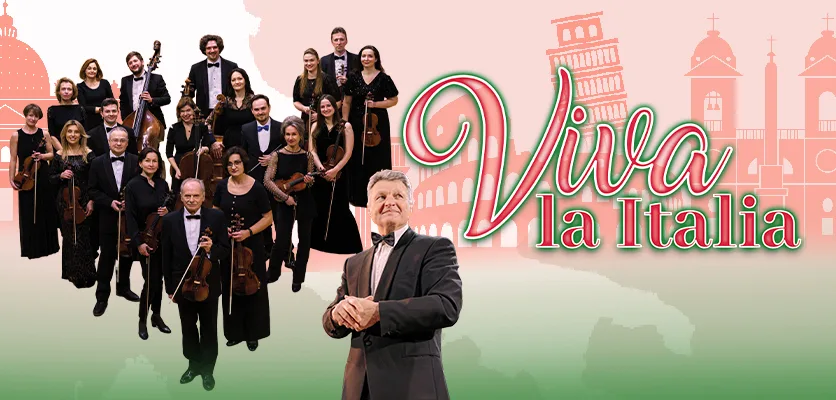
Viva la Italia
S.Lyudkevych Concert Hall
220-550
Performers:
- Olena Matseliukh, organ
- Academic Chamber Orchestra “Lviv Virtuosos”
- Serhii Burko, artistic director
- Yurii Skrypnyk, conductor
Programme:
- Arcangelo Corelli. Concerto in D major No. 4, Op. 6
- Giuseppe Torelli. Concerto in A minor No. 2, Op. 8
- Antonio Vivaldi. Concerto Madrigalesco, RV 129
- Federico Maria Sardelli. Concerto da chiesa / Church Concerto
- Ottorino Respighi. Suite No. 3 for String Orchestra “Antiche Danze ed Arie per Liuto / Ancient Airs and Dances for Lute”
- Remo Giazotto — Tomaso Albinoni. Adagio
- Roberto Di Marino. Jasmine
- Tango Trentino
- Rolling Strings
“Ponte” (“bridge”) is the name Italians give to a sequence of days off taken between public holidays, allowing time for travel, meeting friends, and attending cultural events. On 30 April, thousands of Italians will also be enjoying a festive break, as the country concludes celebrations of Festa della Liberazione (Liberation Day) and prepares for Festa dei Lavoratori (International Workers’ Day). We invite you to experience the spirit of festive Italy together with Lviv’s distinguished ensemble — the Academic Chamber Orchestra “Lviv Virtuosos”, conducted on this evening by the orchestra’s friend from Rivne, Yurii Skrypnyk.
What makes Italian music so distinctive? Since the very emergence of secular music-making, Italians seem to have known that everything must possess flavour, colour, and a zest for life. Opera was born here, and ballet also traces its origins to Italy. Music came to represent not only art but also competition, as every accomplished performer sought to demonstrate virtuosity among dozens of rivals, or even to compete expressively with an entire orchestra — a dynamic that shaped the genre of the instrumental concerto.
Arcangelo Corelli was one such virtuoso, recognised throughout Italy. At not yet seventeen, he surpassed many talented contemporaries and was admitted to the Accademia Filarmonica of Bologna, which a few years later also welcomed Giuseppe Torelli. Unlike Corelli, a devoted admirer of Rome, Torelli, apart from several years abroad, remained in Bologna. Thus, the two Baroque virtuosi never met in person, yet their music frequently appears side by side in concert programmes. Completing this line of Italian Baroque masters is Antonio Vivaldi, who in his concerto drew upon themes from lyrical madrigals. Perhaps one of the foremost contemporary experts on Vivaldi is Federico Maria Sardelli — musicologist, composer, chief conductor of Accademia Barocca di S. Cecilia, founder of the Baroque ensemble Modo Antiquo, and a two-time Grammy nominee — whose music is also presented in this programme by the Lviv Virtuosos.
A bridge to the present is formed not only through echoes of sacred music in Sardelli’s concerto, but also in Ottorino Respighi’s Ancient Airs and Dances for Lute. Each of the four movements of this suite incorporates melodies by long-forgotten composers of the Renaissance. In a similar way, Remo Giazotto revived musical material attributed to Tomaso Albinoni, creating one of the most enigmatic works of the twentieth century — the famous Adagio.
The dream of Roman holidays, immortalised in the classic film of the same name, will be evoked this evening through the music of another contemporary composer, Roberto Di Marino. Three of his pieces will conclude both the concert and this musical journey.