
Trio Immersio Vienna
Концертний зал Людкевича
220–450
Artists:
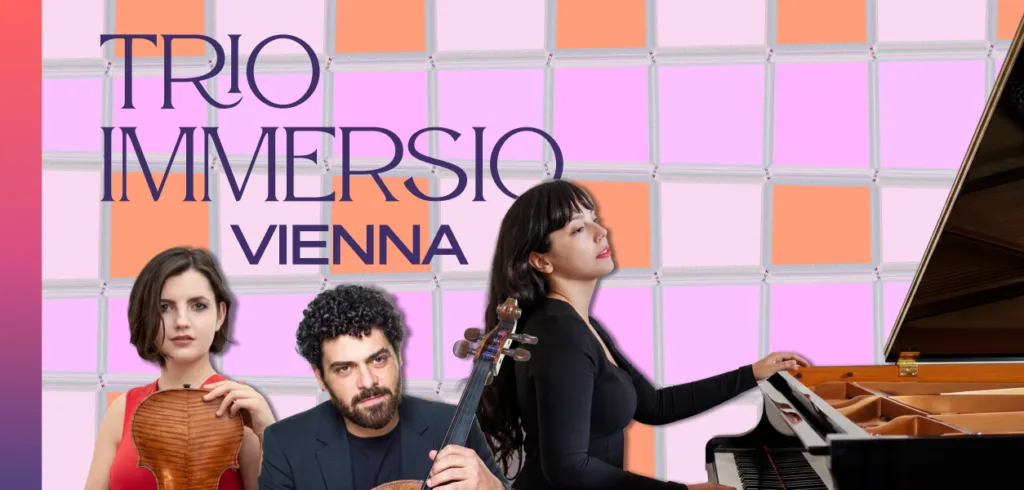
- Trio Immersio Vienna:
- Vira Zhuk, violin
- Ofer Canetti, cello
- Mariam Vardzelashvili, piano
Program:
- Franz Schubert. Trio No. 1 in B-flat major, D. 898
- Stanislav Liudkevych. Nocturne
- Robert Schumann. Trio No. 3 in G minor, op. 110
Three views on the form of the piano trio — a genre that in the 19th century became an intimate diary for composers. Schubert writes on the verge of death, Schumann — five years before the breakdown from which he will never recover. Between them sounds the Ukrainian voice of Stanislav Liudkevych.
Schubert began his first Trio in B-flat major in 1827 — a year before his death. Despite this circumstance, the work turned out to be lively and energetic, with an incomparable lyricism. Schumann described the Trio as follows: “One look at Schubert’s Trio, and the troubles of our human existence disappear, and the whole world is fresh and bright again.”
Schumann’s Third Trio in G minor was written in 1851 in Düsseldorf, where the composer worked as director of the municipal orchestra. On October 11, Clara Schumann wrote in her diary: “Robert is working diligently on the Trio for piano, violin and cello but he does not let me hear anything until he has completely finished it. I only know that it is in G minor.” The first run-through in two weeks made a deep impression on Clara: “It is original and increasingly passionate, especially the Scherzo, which takes you to the greatest depths.”
This is Schumann’s last piano trio, a work that has almost disappeared from the repertoire today and is sometimes cited as evidence of the composer’s weakening creative powers. But the listener, captivated by the passion of the Allegro, the warmth of the slow movement and the solid unity of the scherzo, is unlikely to agree with such a verdict. Five years after this, the Schumann Trio will attempt to drown itself in the Rhine. Two years later, it will die in a mental hospital in Endenich.
Between the two large-scale romantic canvases, the Nocturne by Stanislav Liudkevych, the patriarch of Ukrainian classical music of the 20th century, will be heard. The nocturne genre, traditionally intimate, nocturnal, contemplative becomes here a bridge between Schubert’s light and Schumann’s anxiety.
With the support of the Austrian Cooperation Office in Lviv and Ukraine Office Austria under the Austrian Foreign Ministry