
Peal of Bells
S.Lyudkevych Concert Hall
220-700
Artists:
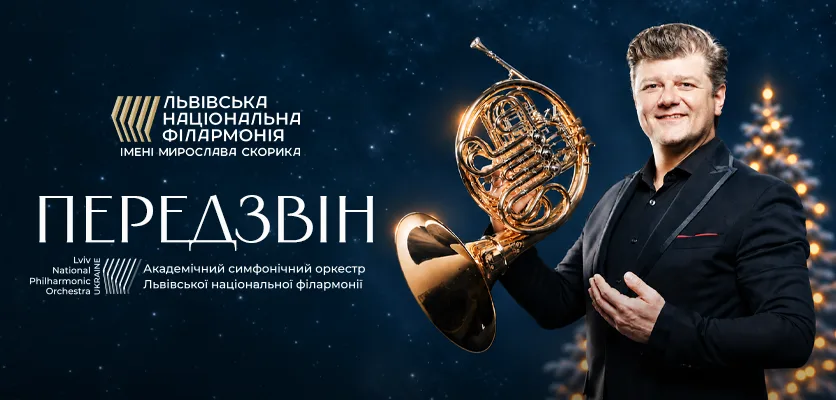
- Academic Symphony Orchestra of the Lviv National Philharmonic
- Radek Baborák, horn (Czech Republic)
Program:
- Antonio Rosetti. Horn Concerto
- Karel Svoboda. Orchestral Suite from the film “Three Wishes for Cinderella”
- Antonín Dvořák. Symphony No. 8
The Cinderella fairy tale was meant to be filmed in the warm season, but director Václav Vorlíček wanted the story to unfold in winter and postponed filming for several months, until the snow fell. This is how the film came to feature the snow-covered forests of Bohemia and Moritzburg Castle under snow, and “Three Wishes for Cinderella” (1973) became a Christmas film shown every year in the Czech Republic, Slovakia, Germany and Norway. Its music was written by Karel Svoboda, the author of dozens of songs and the music for the animated series “Maya the Bee” and “Vicky the Viking”.
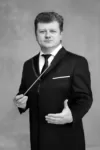
This evening, Radek Baborák will both conduct and play the solo horn part. He was born in 1976 in Pardubice and at the age of eighteen became principal horn of the Czech Philharmonic. He went on to play with the Munich Philharmonic and the Bamberg Symphony Orchestra, and from 2003 to 2010 he was principal horn of the Berlin Philharmonic. Seiji Ozawa once said that when Baborák plays, everything seems incredibly easy.
The program spans three centuries of Czech music. Antonio Rosetti was born around 1750 in northern Bohemia. He served for sixteen years in the court orchestra of the Prince of Oettingen-Wallerstein, becoming its Kapellmeister in 1785. Around 1780, two Bohemian horn players, Joseph Nagel and Franz Zwierzina, joined the orchestra. They were paid unusually generously, and Rosetti wrote concertos for two horns for them. His catalogue includes as many as seventeen concertos for solo horn. Musicologists suggest they may have served as a model for Mozart’s horn concertos.
Antonín Dvořák wrote his Eighth Symphony between August 26 and November 8, 1889, mostly in the village of Vysoká, where he had a summer house and where he worked best. In his own words, he wanted to express his musical ideas differently from the usual, generally accepted forms. The Symphony in G major opens with an elegiac cello melody in G minor. This melody returns at the start of each major section of the first movement, like a narrator. The third movement sounds like a gently melancholic waltz, and for its middle section Dvořák borrowed a melody from Toník’s aria in his comic opera “The Stubborn Lovers”. The finale opens with a trumpet fanfare, from whose motif a series of variations grows.
The premiere took place on February 2, 1890, at the Rudolfinum in Prague, conducted by the composer. That April, Dvořák conducted the symphony in London, and the British press called him the only living composer worthy of being named Beethoven’s successor. The Berlin publisher Fritz Simrock, who printed most of Dvořák’s works, could not agree with him on a fee, so the symphony was published by the London firm Novello. Hence its second title, “English”.