
Сніжність
S.Lyudkevych Concert Hall
220-700
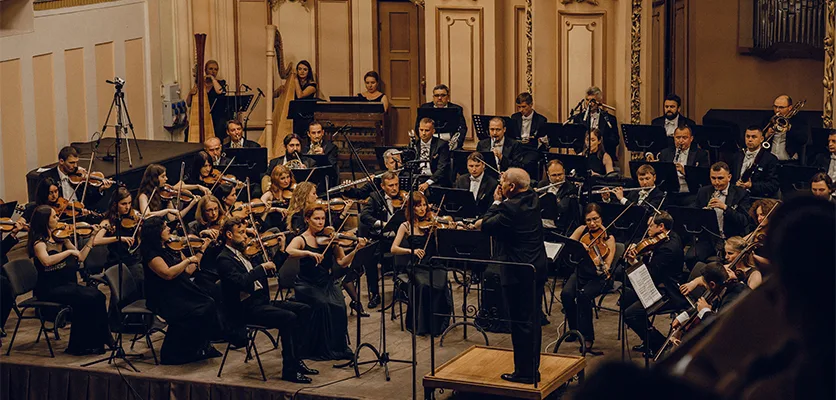
Performers:
-
Yelyzaveta Pochebut, piano
-
Lviv National Philharmonic Symphony Orchestra
-
Yurii Litun, conductor
Program:
- Stanisław Moniuszko – The Fairy Tale (Winter’s Tale), Fantastic Overture
-
John Field – Piano Concerto No. 2 in A-flat major, H. 31
-
Maurice Ravel – Mother Goose (Ma Mère l’Oye), Suite
-
Paul Dukas – The Sorcerer’s Apprentice, Scherzo based on Goethe’s ballad
In 1848 Stanisław Moniuszko wrote an overture with the plain title Bajka (“Fairy Tale”) and a French subtitle, Conte d’hiver, a winter’s tale. Which fairy tale he had in mind, the composer never said. The overture has no literary plot, only contrasting themes that form a musical narrative, and listeners supply the characters themselves. Moniuszko first described Bajka as a fantastic overture. Its form is indeed free, and scholars hear in it something close to a Chopin ballade, transferred to the orchestra.
John Field, a native of Dublin, is remembered as the creator of the nocturne, the piano “night piece” that Chopin would later make famous. Of Field’s seven piano concertos, the Second, in A-flat major, written no later than 1811, has always been the most popular. It was one of the young Chopin’s main models when he began work on his own concertos. Field’s style is easy to recognise in the first movement: three times, a lyrical episode with a harp-like accompaniment in the left hand suddenly turns into a lively Irish reel. The soloist is Yelyzaveta Pochebut.
Maurice Ravel wrote Mother Goose (Ma mère l’Oye) for Mimi and Jean, the children of his friends Ida and Cipa Godebski, as five pieces for piano four hands based on French fairy tales by Charles Perrault, Madame d’Aulnoy and Madame Leprince de Beaumont. When it came to the premiere, the children lost their nerve, so on 20 April 1910 the work was played by two other young pianists. The following year Ravel orchestrated the suite. He included quotations from the tales in the score. Above “Tom Thumb” is a line about the boy who hoped to find his way home by his breadcrumbs, only to discover that the birds had eaten them, and the birds can be heard in the orchestra. In the conversation between Beauty and the Beast, the clarinet takes the part of Beauty and a deep contrabassoon that of the Beast, so their dialogue can be followed like a scene in the theatre. The suite ends with “The Fairy Garden”, in which celesta, harp and solo violin slowly lead the music to a luminous finale.
Paul Dukas wrote The Sorcerer’s Apprentice in 1897, exactly one hundred years after the Goethe ballad on which it is based. Left alone by the old sorcerer, the apprentice enchants a broom to carry water, then finds he does not know how to stop it. The story hardly needs retelling, because it is all there in the music. The broom marches in the bassoons, the water rises with the orchestra, and when the apprentice in desperation splits the broom with an axe, two sharp chords and a pause are followed by even wilder chaos. At the end, as the sorcerer returns and restores order, the apprentice’s theme is heard on a solo viola, as though asking forgiveness. Dukas conducted the premiere himself on 18 May 1897, and the work brought him immediate fame. Thanks to Walt Disney’s Fantasia (1940), in which Mickey Mouse enchants the broom, even those who have never heard Dukas’s name recognise this music within the first few bars. Dukas was so demanding of himself that a few weeks before his death he burned part of his own manuscripts. The scherzo about an apprentice whose magic got out of hand is still his best-known work.